Support What Could Split Apart
Cabling and bracing in Lakeland prevent weak unions and co-dominant stems from failing during storms.
When a tree develops two trunks that grow at a narrow angle, the connection between them is weak. As the trunks gain weight and the canopy fills out, the pressure at the union increases. In Lakeland, where wind and rain are constant during storm season, these weak unions often split, taking down large sections of the tree and anything underneath. Cabling and bracing provide external support that holds the trunks together and reduces the chance of failure.
The Tree Lady Company installs professional-grade cables and braces in trees with structural defects such as co-dominant stems, weak V-shaped crotches, or heavy limbs that extend too far from the trunk. The hardware is placed high in the canopy to limit movement without restricting all growth. This allows the tree to flex in the wind but prevents the kind of extreme motion that causes splitting. Cabling is often paired with structural pruning to reduce weight and improve balance, which makes the support system more effective and extends the life of the tree.
If you have a tree in Lakeland with a visible split or weak union, contact The Tree Lady Company to find out if cabling can help.
How the System Holds the Tree Together
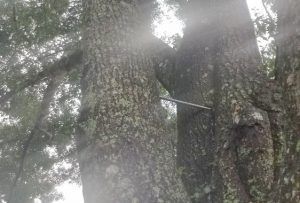
The arborist inspects the tree to locate weak unions, measure the diameter of the trunks, and determine where the cable should be installed. In Lakeland, the work is done with professional hardware that is rated for outdoor exposure and high loads. The cable is anchored into the wood above the weak point, typically about two-thirds of the way up the union, so it catches the trunks before they pull apart.
After installation, you will notice the tree moves less during high winds and the union stays closed instead of flexing open. The system does not stop all movement, which is important because trees need to flex to build strength, but it does prevent the kind of wide swings that lead to splitting. Cabling can add years to the life of a tree and prevent the sudden failures that damage roofs, vehicles, and fences.
Cabling is especially effective for species prone to splitting, such as Tabebuia trees, and for mature trees that would be expensive or impossible to replace. The hardware is checked periodically to make sure it remains secure and the tree has not grown around it in a way that creates new problems. This service is focused on safety, aesthetics, and long-term preservation, not just temporary fixes.
Homeowners often wonder if cabling will damage the tree, how long the system lasts, and whether it works on older trees. Here are the answers that help most people decide.
A Few Things Worth Clearing Up
If you have a tree with weak unions or co-dominant stems that you want to save, cabling and bracing from The Tree Lady Company can reduce risk and add years to its life. Learn more by contacting the team in Lakeland.